.webp)
South Korea just hit its 300,000 international student target two years early, launched a Top-Tier visa for global tech talent, and opened a three-year workation visa, all in the space of a year. While Australia raises fees and the United States loses confidence, Korea is quietly assembling a talent brand that connects STEM, language study, and long-term careers.
For a decade, most families thought of Korea as a culture export — K-pop, K-drama, food, and fashion. That reputation was earned, and it was enormous. But it also created a blind spot. Underneath the cultural brand, Korea has been building something far more strategic: a deliberate, government-backed plan to become one of the world's leading study and talent destinations. And in 2025 and 2026, that plan started delivering results faster than almost anyone expected.
This matters for every school and university that recruits internationally — not only the ones in Seoul. When a new destination becomes credible, it reshapes the choices families make everywhere else.
Start with the headline number. In 2023, Korea's Ministry of Education launched the Study Korea 300K Project, a plan to attract 300,000 international students by 2027 and push the country into the top ten global study-abroad destinations. It was an ambitious target for a country that had historically been a source market, not a destination.
By August 2025, total foreign enrolment reached 305,329 — hitting the 2027 target roughly two years ahead of schedule. Of those, 225,769 held a D-2 visa for university degree programmes and 79,500 were studying on D-4-1 Korean language visas. Read that split carefully, because it tells the real story: language study is not a side channel in Korea. It is a front door. Nearly one in four international students arrives to learn the language first, and many convert into degree pathways from there.
Then came the talent infrastructure. In March 2025, Korea introduced its Top-Tier Visa, aimed squarely at world-class professionals in semiconductors, displays, batteries, biotechnology, robotics, and defence. It grants a resident status, allows permanent residency after just three years, gives spouses unrestricted work rights, offers up to a 50 percent income tax reduction for as long as a decade, and processes applications online within two weeks. In July 2026, the government expanded the linked K-Tech Pass programme — run by KOTRA — to cover semiconductors, displays, batteries, bio, artificial intelligence, robotics, defence, and advanced mobility.
And most recently, on 30 June 2026, Korea made its F-1-D workation visa official after a pilot that ran from January 2024 to May 2026. It lets people employed by overseas companies live in Korea while working remotely, for up to three years, with family members included and relaxed income requirements for younger applicants and those settling outside the capital.
Look at those four moves together — a student recruitment target, a STEM talent visa, a tech-sector fast track, and a remote-work visa. Korea is no longer selling culture alone. It is connecting language study, degree programmes, high-tech careers, and long-term residency into a single, legible story: come to learn, stay to build and there is a path for each step. That is what a talent brand looks like.
The reason Korea's momentum matters is that it is happening while several traditional destinations are moving in the opposite direction. In international recruitment, families do not evaluate a country in isolation. They compare. And the comparison set in mid-2026 has rarely looked more lopsided.
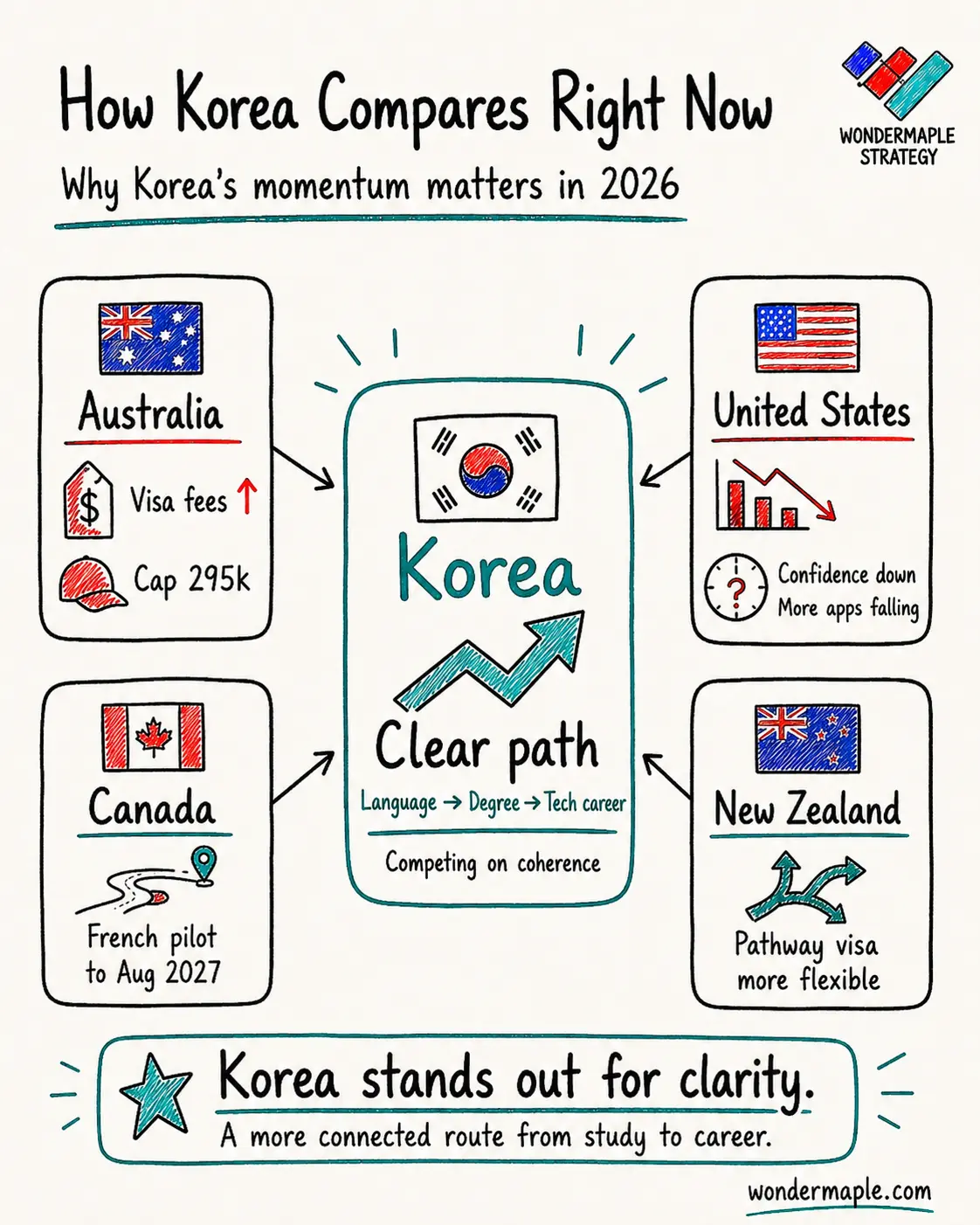
Australia is now the clearest caution story. From 1 July 2026, the student visa application charge rose to A$2,500 and the Temporary Graduate visa charge climbed to A$5,750, both up around 25 percent. At the same time, the 2026 international enrolment cap sits at 295,000. Cost and access have become front-line recruitment issues, and price-sensitive families — especially from South and Southeast Asia — now weigh the visa fee alongside tuition, housing, and proof of funds as a single affordability signal.
The United States is dealing with a confidence problem rather than a cost one. Reporting in July 2026 found that more than half of surveyed US colleges saw international application declines for 2026, with India among the hardest-hit source markets, and separate analysis estimated F-1 visa issuance running about one-third below normal through September 2025. The institutions remain world-leading, but families are no longer only asking whether they can get admitted. They are asking whether they can arrive on time, stay compliant, and access work options.
Canada and New Zealand are playing the flexibility card. Canada extended its Francophone Minority Communities Student Pilot to August 2027, giving French-speaking students outside Quebec a targeted, permanent-residency-linked route. New Zealand updated its Pathway Student Visa from 20 July 2026, letting some students switch disciplines without a new visa and adding English-study flexibility. Both are narrow, deliberate signals of welcome at a moment when the biggest destinations are associated with caps, refusals, or rising costs.
Set against that backdrop, Korea's position is distinctive. It is not competing on being the cheapest or the most prestigious. It is competing on coherence — a clear line from language study to a degree to a genuine high-tech career, backed by visas that were designed to connect rather than to gatekeep.
If you recruit for a university, language school, or pathway provider in Korea, the policy tailwind is real — but a tailwind only helps schools that have set their sails. Here are three moves that convert national momentum into actual enrolments.
1. Sell the pathway, not just the programme. Korea's advantage is that the steps now connect: language study, degree, and a credible route into semiconductors, AI, and advanced industries through the Top-Tier and K-Tech Pass visas. Most school websites still describe a single programme in isolation. Map the whole journey instead — show a family exactly how a language year can lead to a degree and then to a real career pathway. Families are not buying a course. They are buying a future, and Korea can now credibly sell one.
2. Fix the English-language gap in your messaging. Korea's own strategists acknowledge that English-language support and post-study clarity are still weak spots for many international families. That is a marketing opportunity hiding as a service problem. Publish clear English-language content on what support exists, how much Korean is really needed to start, and what employment looks like after graduation. The school that answers these questions plainly will out-convert the school with the more impressive campus but the vaguer promise.
3. Ride the culture brand, then redirect it. The K-culture interest is your top-of-funnel gift — use it, but do not stop there. Lead with the cultural draw that brought a student to your page, then pivot fast to substance: outcomes, industries, language progression, and settlement. The goal is to turn passive interest in Korea into an active plan to study and build a career there. That redirect, done well, is the entire difference between a follower and an applicant.
If you recruit outside Korea, the instinct is to ignore all of this as someone else's good news. That would be a mistake. A rising destination does not just add a competitor — it raises the bar on what families expect everyone to explain.
The specific reaction depends on where you sit. If you are in a high-cost destination like Australia, you can no longer let price sit quietly in the background; you need transparent total-cost calculators, earlier refund-policy conversations, and hard proof of graduate outcomes to justify the premium. If you are in the United States, the job is to rebuild procedural confidence — visible pre-arrival support, visa-slot monitoring, and honest, parent-facing risk communication. And if you are a challenger destination of any kind, Korea has just written the playbook: stop selling a single programme, and start selling a connected pathway from study to work to settlement.
The through-line is the same everywhere. Families in 2026 are comparing headline prestige against pathway certainty, total cost, and risk. The destinations winning attention are the ones making that comparison easy and honest. Every school, in every country, is now being judged on how clearly it can answer the questions Korea has decided to answer out loud.
This is the exact work we do. When we were helping some of our clients navigate a shifting recruitment landscape, the pattern was always the same: the policy environment changed faster than their messaging, and their website was still selling last year's story to this year's families.
At WonderMaple Strategy, we help schools, universities, learning centres, and EdTech companies turn policy shifts into recruitment advantage. That means mapping the full student journey into a pathway story families can actually follow, rewriting programme pages so they answer the real questions — cost, language, outcomes, and post-study options — and building the digital presence that makes a school visible at the exact moment a family is comparing destinations. Having recruited more than 2,500 students earlier in our career, and working across North America and Asia, we understand both the source-market psychology and the destination-side messaging that moves a family from interest to enrolment.
Korea's rise is a preview, not an exception. Destinations will keep changing the rules, and the schools that win will be the ones whose message keeps pace. If your recruitment story has not been updated for the 2026 landscape, that is where we start.
Want to see where your recruitment messaging is losing families to newer destinations? Get in touch with WonderMaple Strategy and we will show you where the gaps are and how to close them.
WonderMaple offers a free, no-commitment recruitment audit to help you see exactly where your school is losing inquiries and what to fix first.
Make your business unforgettable in every interaction.


.webp)
.webp)
.webp)
.webp)
.webp)
.webp)
.webp)
.webp)
.webp)
.webp)
.webp)
.webp)
.webp)
.webp)
.webp)
.webp)
.webp)
.webp)
.webp)
.webp)
.webp)

.png)




.png)





.webp)